Parsons is a U.S. based multinational engineering firm focused on defense, intelligence, and infrastructure. The company has long embraced technology to deliver complex projects efficiently, and as part of their commitment to AI adoption, the company launched an enterprise rollout of OpenSpace—an AI-powered reality capture platform. AI Reality Captures present a massive opportunity. If teams can automate the process of capturing and sharing site progress, they can significantly reduce delays and disputes, improve quality procedures by solving issues faster, and reduce the overall delivery risk for Construction projects.
Rolling out a new technology across decentralized, project-driven organizations brings inherent complexity. Project teams operate under intense pressure and tight timelines—leaving little room for training, experimentation, or process disruption. Typically, the appetite for change is low, especially when short-term deliverables are at stake.
At an enterprise level, process visibility across projects is limited. With each project running independently, teams often re-invent processes, duplicating effort and missing opportunities to scale what works. As a result, project knowledge rarely travels—creating friction, fragmentation, and inconsistent outcomes across the portfolio.
In this case, for Parsons to succeed in a large scale OpenSpace rollout, it was paramount to overcome both local project resistance as well as systemic and corporate knowledge transfer challenges. SEKTOR was brought in to support both technology and process adoption—delivered as a single, integrated solution.
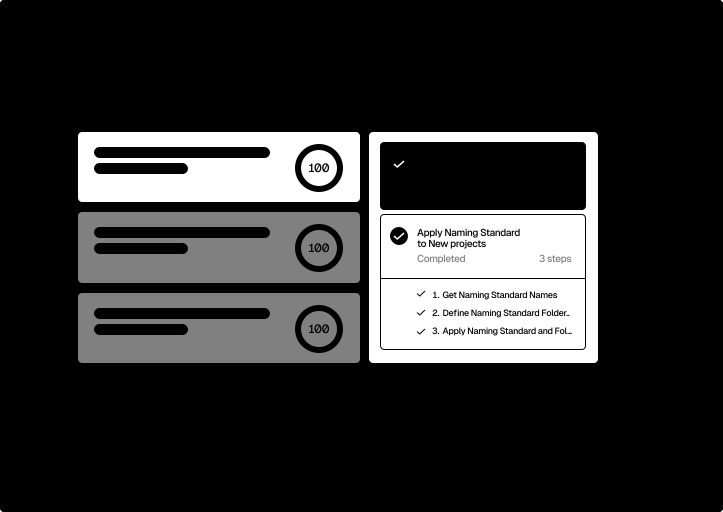
At the core of SEKTOR’s approach was the automation of workflow upgrades—a task that is normally one of the most time-consuming parts of tech adoption, especially in construction where each project has different processes and delivery models. SEKTOR eliminated the need to build workflows from scratch using a pre-trained system to map OpenSpace into real project workflows—covering quality, safety, progress tracking, and as-built documentation.
“What sets Parsons’ projects apart is our expertise in deploying the latest technologies, which has enabled a seamless integration of AI and ushered in an era of unprecedented efficiencies and capabilities.”
-Pierre Santoni, President, Parsons EMEA
SEKTOR handled execution end-to-end: from coordinating camera shipments and enabling teams to start capturing, to delivering upgraded procedures that made OpenSpace part of daily operations—without requiring behavioral change or retraining. To ensure consistency at scale, SEKTOR built a dedicated knowledge network across all active projects and provided “always-on” support, with an average ticket resolution time of just 12 minutes. SEKTOR’s standardized rollout model and automated workflow upgrades cut admin workload by 90%. Once in place, each new project required minimal setup—cutting rollout costs by 75% and enabling predictable, high-speed adoption without increasing internal overhead.
In just a few months, SEKTOR upgraded Parsons’ workflows across 50+ active projects, saving thousands of hours in administrative and coordination work. This allowed teams to focus on delivery—without disrupting day-to-day operations. Digital inspections increased by 30%, and over 45,000 quality issues were resolved through semi-automated workflows using OpenSpace Field Notes.
SEKTOR’s structured rollout enabled Parsons to recover their full license cost in just 84 days—a timeline that typically takes many months or even years. They also saved $1.4M in internal resource costs by eliminating manual training, onboarding, and support overhead. More than a rollout, SEKTOR established a repeatable deployment system—turning OpenSpace into a high-speed, high-return asset.
Unibail-Rodamco-Westfield (URW), the owner of the €1.5B Uberseequartier project spanning 419,000 sqm in Hamburg’s HafenCity, embarked on one of the most ambitious urban developments in Europe. The mixed-use site integrates residential, commercial, and leisure spaces with a state-of-the-art cruise terminal.
Two years into construction, URW made a technology pivot—replacing its underperforming project management platform with Autodesk Construction Cloud (ACC) and introducing OpenSpace to improve visibility and coordination. With multiple external teams, rising complexity, and a previous tech investment that hadn’t delivered, the pressure was high: the new technology stack had to generate results fast and run without disrupting delivery.
Introducing new platforms mid-project across a €1.5B development created immediate operational pressure. With over 30 external stakeholders—including a supervision consultants and three general contractors—adoption risked becoming fragmented. More than 70% of communication still occurred off-platform via email and WhatsApp, reinforcing inefficiencies and missed insights.
Teams were disappointed with the previous PMIS system, and new tools were seen as disruptive. Without a clear adoption strategy, critical processes - like RFIs and approvals - routinely stalled or bypassed the system. The result: lost traceability, mounting inefficiencies, and over €200K in annual internal support strain, largely due to senior staff being pulled into troubleshooting and training.
"SEKTOR came in at a tough moment for the project and delivered—fast. ACC and OpenSpace were up and running across our teams without any operational disruption."
-Jacques Boursault, Director of Construction Unibail Rodamco Westfield
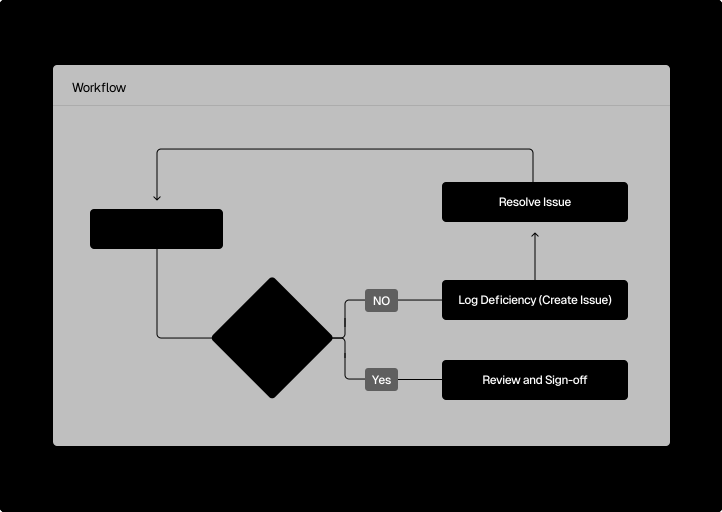
SEKTOR’s goal was to recover software costs fast and eliminate the operational burden of running the tech stack internally. We identified the quality management inspection workflow as the quickest win with the highest ROI potential. SEKTOR restructured the workflow using both ACC and OpenSpace, eliminating over 50% of manual steps and simplifying execution. This became a foundation for broader adoption across site teams.
"The speed at which SEKTOR got everyone up and running gave us confidence and peace of mind that our investment would be a success."
-Viktor Eskioglou, Construction Manager Unibail Rodamco Westfield
Within 30 days, SEKTOR trained and activated 330 users, focusing on documentation, coordination, and role-specific workflows. To eliminate friction, SEKTOR delivered fast troubleshooting, workflow-specific guidance, and maintained a constantly updated knowledge base. This removed the need for internal teams to spend hours supporting platforms or answering repetitive questions.
SEKTOR’s performance-first model delivered tangible results within weeks. Within just 30 days, 330 external consultants were fully trained on the upgraded digital quality workflows. Off-platform communications—including emails and WhatsApp messages—were reduced by 75%, significantly improving collaboration and data traceability.
With an average issue resolution time of just 30 minutes—ten times faster than the SaaS industry average—SEKTOR dramatically reduced tech friction and internal support overhead. As a result, the project fully recovered its software investment in only 120 days.
SEKTOR delivers the adoption of Procore Software at the $1.5B Integrated Casino Resort in Athens.

Terna, one of Europe’s leading construction groups, manages high-profile, complex projects—from large mixed-use developments like City of Dreams Mediterranean and the Integrated Casino Resort in Athens, to mission-critical infrastructure such as Microsoft Data Centers. As part of its digital strategy, Terna deployed multiple project management solutions across its portfolio to streamline operations, improve efficiency, and modernize delivery.
The construction industry faces a well-known problem: a shrinking talent pool and a growing digital skills gap. For Terna, the issue wasn’t just about adopting new software—it was about making it stick in an environment where skilled engineers are hard to find, and site teams are often stretched thin. Without widespread adoption, the technology’s promise of improved productivity would remain unrealized. On top of that, teams were naturally skeptical of new tools unless they saw clear, immediate value.
SEKTOR stepped in with a fully managed adoption service designed to unlock productivity—without adding pressure on already overloaded teams. The focus was on automating time-intensive workflows and embedding digital processes directly into daily operations. Key site activities like RFIs, quality control, and daily reporting were optimized through streamlined digital procedures. SEKTOR worked closely with project teams to ensure adoption was fast, and aligned with how people actually work on-site.
Within weeks, productivity gains were measurable. By eliminating redundant admin tasks and digitizing manual processes, Terna saved nearly 5 hours per engineer per week, the increased output per engineer across 3 major projects equalled 12 full-time employees. SEKTOR enabled these productivity gains by streamlining how work actually gets done on site. Rather than introducing new systems that required teams to change their routines, SEKTOR aligned technology with existing workflows—making adoption fast, intuitive, and low-friction.